

You’re standing in a busy airport terminal.
Suddenly, you see people sprinting—some running toward a gate, others running away. A man drops his bag and shouts something you can’t quite hear.
What’s happening? How will you respond?
Maybe he’s late for his flight. Maybe there’s an emergency. Maybe it’s a bomb threat. Or maybe it’s a prank or a flash mob.
Depending on how you interpret the scene, your response changes.
You may run for safety or find security. You may stay calm and wait. You may help the man with his bag.
But without knowing the full story, you’re left asking, “What is going on?” and “What should I do?”
Knowing the full story is the difference between stumbling in confusion and stepping forward with confidence. It’s the difference between living with a question mark over your life and living with an exclamation point.
And for Christian leaders, that’s exactly how work often feels.
You know a lot of the story. You know about Jesus. You know your work matters. You know God wants to use you.
But there are still parts of the story you are unsure about.
You’re unsure how to integrate your faith. You wonder what you’re really called to do. You question why your work matters in the bigger picture.
Often, the reason we fall short of living a life of significance isn’t because we don’t care, but because we’re missing part of the story.
When we don’t know the full story, we don’t know what is happening around us and we don’t know what to do. Without the full story, we don’t know the scene we are in nor the role we are called to play. That’s why work so often feels confusing, disconnected, or even burdensome. We don’t see the beauty of the story God is writing, and we don’t know practically how we fit into it.
But when we see the full story God is writing, we can step into our role with confidence.
The Storyline Arc
Every movie—whether it’s The Lord of the Rings, The Sandlot, or Shrek—follows a similar storyline arc. They all have different settings, different characters, and different stakes, but the key movements of the story are the same.
The storyline arc has five acts.
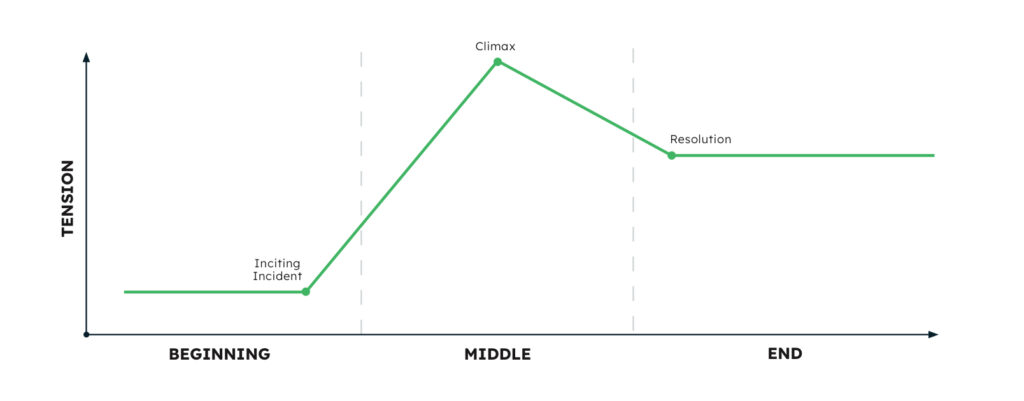
Act I of a storyline always starts with context. This is where the world is created and the author establishes what is normal. Then an inciting incident disrupts that normality, creating Act II: the rising tension. In this act is where tension rises and conflict builds. Eventually, the story reaches Act III: the climax—a decisive moment where the protagonist triumphs. The fourth Act is the falling tension as the consequences of the climax fall into place, until the story reaches its fifth and final act: the resolution. This is where everything is set right and a new normal is established.
Whether it’s Benny the Jet’s journey to get the Babe Ruth baseball back, Frodo’s journey to destroy the One Ring in Mordor, or Shrek’s hero journey to reclaim his swamp, the storyline arc can be seen. It’s found in every good story—including the greatest story ever written: God’s.
The Kingdom Storyline
When you understand the arc, everything within the story begins to make sense. When we miss the arc, things begin to feel random. Similarly, when we see the storyline that God is writing, the Bible begins to make sense, our life makes sense, our work makes sense.
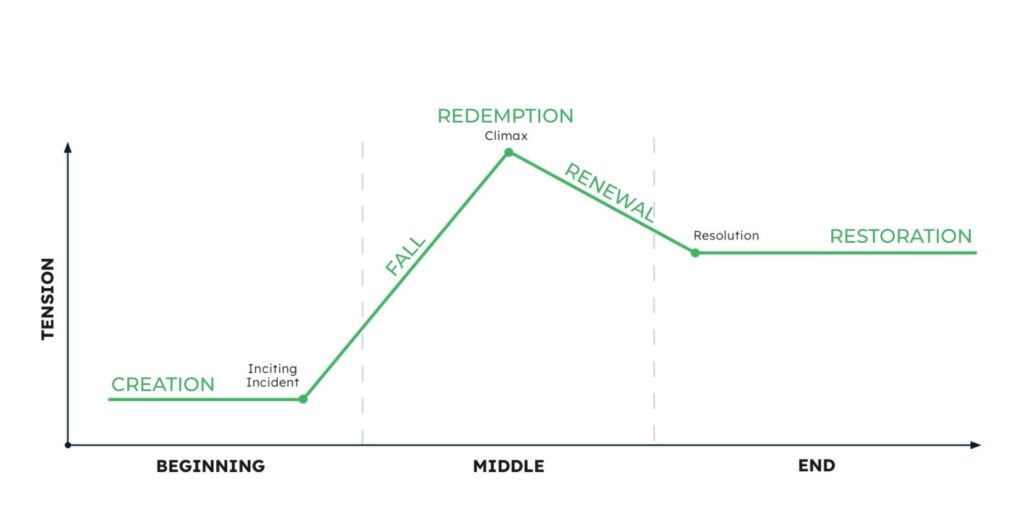
The Kingdom Storyline is a simple tool that I use to show the entire Bible through the lens of a story using the simple 5-act structure referenced above. This simple visual shows two big truths for business leaders.
- God is in the Kingdom-building business.
- God has established a partnership with you to build his Kingdom.
Act I – Context: Creation (Genesis 1–2)
Partnership is established & Mission is defined.
Creation sets the context. God creates the world and calls it good. Humanity is made in God’s image and immediately given responsibility—to work, to steward, and to rule under God’s authority.
In this stage, God establishes the design for all of life: humanity, creation, and work. From the beginning, work is given as a calling. It’s an act of worship and an essential ingredient for human flourishing.
The world God creates is good, but not perfect. It is unfinished—full of untapped potential that humanity is called to cultivate. He then calls man to be fruitful and multiply, subdue the earth and have dominion over it (Gen. 1:26-28).
In Genesis 1-2, God establishes a partnership with mankind and gives us a mission to build the Kingdom together.
Act II – The Rising Tension: The Fall (Genesis 3)
Partnership is strained and Mission is compromised
With God’s creation and its new normal established, an inciting incident disrupts the harmony between God and humanity ushers in Act II: The Fall.
In Genesis 3, Adam and Eve disobey God and eat from the tree of the knowledge of good and evil. Sin enters the world, fracturing humanity’s relationship with God, with one another, and with creation itself. One consequence of the Fall is that work becomes harder and relationships become strained. The Kingdom-building partnership with God is fractured.
This moment sparks the rising tension between God and humanity. Sin separates mankind from God. The Old Testament tells the story of Israel’s repeated attempts to return to God’s original design—perfect harmony—but sin continues to fall short. The tension builds until the Old Testament ends with 400 years of silence.
All seems lost. The partnership between God and mankind seems to be irreparable and the God’s kingdom-building mission is compromised.
Until the hero shows up.
Act III – The Climax: Redemption (Jesus)
Partnership is restored and Mission is reclaimed.
The climax of God’s story is found in one name: Jesus.
Through His birth, perfect life, sacrificial death, and resurrection, Jesus defeats sin. The separation from God that once seemed insurmountable is reconciled through the cross.
Jesus doesn’t just redeem our relationship with God—He reestablishes God’s intention for creation. We are restored to relationship with God both now and forever.
The partnership is restored and the mission is reclaimed. The feeling around God’s Kingdom-building venture goes from hopeless to hopeful; from doubtful to imminent. God’s people then enter into a new season.
Act IV – The Falling Tension: Renewal (The Last Days)
Partnership is strengthened and Mission is advancing
The fourth stage of the Kingdom Storyline is Renewal. This is the stage we’re living in now—the “last days” (1 Peter 4:7; 1 John 2:18; Hebrews 1:1–2; Acts 2:17).
“Last days” is an ancient war term describing the period between the decisive battle and the final surrender. The outcome is no longer in doubt—the winning side is known—but resistance still exists as the final skirmishes play out.
This is where we are now. We live between the cross and Jesus’ final return. We are in the already–not yet. Jesus has already won the war, but the Kingdom has not yet been fully realized.
In this season, God has strengthened his partnership with us as he gives us the Holy Spirit. In this season, God is renewing all things to Himself (Revelation 21:5). He is restoring creation to its original intention—and He invites us to join Him in that work.
Together, we are not only renewing souls, but renewing all of creation. Continuing the work He gave us at creation: to be fruitful, multiply, subdue the earth and have dominion over it (Genesis 1:26-28).
The Renewal Stage shows a partnership that is strengthened and a mission that advancing towards the final.
Act V – The Resolution: Restoration (Revelation 21–22)
Partnership is fulfilled and Mission is completed
The fifth and final stage of the Kingdom Storyline is Restoration. In Revelation 21–22, Jesus returns and establishes the new heaven and new earth. Sin is fully removed. Creation is made new. Everything is finally set right. God has restored everything back to his initial design.
In this stage, our partnership is fulfilled as there is no more sin and we are in perfect harmony with God. Also, the mission is completed as he has renewed all things to himself.
God has returned everything to his initial design-perfection. But, it looks different then how He began. Similar to movies that we see today, the hero often returns back to where he or she started, but a transformation has occurred.
Like every great story, the hero returns home—but everything has changed. Frodo returns to the Shire, Shrek returns to his swamp, and Benny the Jet returns to the baseball diamond—but none of them return to exactly what they left; they return to something restored and transformed.
In God’s story, he doesn’t return us to a garden like the beginning of the story. He describes a city—with streets of gold.The end isn’t a return to where we started. It’s a step into something new—something that has been built.
We don’t step into a garden. We step into a kingdom.
Our Kingdom-building partnership finally accomplishes the mission and gets to enjoy the fruits of our labor.
Where You and Your Work Fit In The Story
When you see the Kingdom Storyline, you realize that God is in the Kingdom-building business and he has partnered with you to make it happen.
From the beginning, God created you to partner with Him in building a flourishing world. Your work was never meant to be a punishment. It was never meant to be separated from your faith. It was always meant to be a partnership between you and God.
Work is what you were created to do.
When we understand the Kingdom Storyline, one big truth emerges:
You are a Kingdom Builder.
Before you are an employee or a business owner, you are a Kingdom Builder. God has given you your work not just to pay bills or generate revenue, but to build His Kingdom.
In the posts ahead, we’ll explore the Kingdom Storyline in greater detail and how it shapes the way we work.